
Miyazaki
The warmest, sunniest, most surf-committed stretch of mainland Japan — and the first Asia zone on this site. You can surf here year-round in gear that would be inadequate almost anywhere else in the country, which is the actual reason Japanese surfers move to Miyazaki. The surf economy sits in two clusters about fifteen minutes apart: the Kumano and Kaeda belt inland of the beach, and Aoshima village to the south. Honest caveat up front — this is a working regional capital of about 398,000 people, not a resort town.
Straight talk: Some links on this page are affiliate links — if you book through them, Secrets of Surf Travel earns a small commission at no extra cost to you. We only link places and people we'd use ourselves, and coverage is never for sale. Those commissions are what keep this site running and fund the next trip.
Some vacation-rental search links on this page (marked "Search Vrbo rentals," "Search Booking.com stays," or "Search Agoda stays") are affiliate links. Every vendor link below is still a plain courtesy link. As more partnerships come online, more links may earn us a commission; the promise above holds either way.
The one planning fact that actually matters here — typhoons, stated straight: the season runs roughly July through October, peaking August–September, and Kyushu takes real, direct hits. This is not a hedge. A single typhoon dropped 587.2mm of rain on Miyazaki City in one day in October 1939; the Takachiho Railway was destroyed and closed permanently after typhoon damage in 2005. Infrastructure here gets destroyed, not just inconvenienced. What that means for a trip: typhoons generate the swell this coast is known for and most trips in season are fine, but build in slack. Flights to Miyazaki Airport cancel readily, expressways close, and a direct hit means one to three days entirely indoors. Watch the Japan Meteorological Agency forecasts from about five days out, and when local authorities issue evacuation information, follow it — do not go and look at the sea. Travel insurance covering weather cancellation is a genuine buy here, not an upsell.
Getting There
Miyazaki Airport (KMI) sits about 3.2km south-southeast of the city — one of the genuinely close-in airports in Japan. It handled over 3.1 million passengers in 2024 on a single runway. ANA, JAL, Solaseed Air (headquartered here), Peach and Jetstar Japan all serve it; domestic routes reach Tokyo-Haneda, Osaka-Itami and Fukuoka, with international service to Seoul-Incheon and Taipei-Taoyuan. The practical upshot: your board bag can be at a surf shop in Kumano within 15–20 minutes of clearing the terminal, which is a real advantage over most surf destinations. The JR Miyazaki Airport Line runs into the city cheaply, and an airport bus takes roughly 25 minutes.
Note the shape of this — there is no shinkansen to Miyazaki. The Kyushu Shinkansen runs down the west side of the island to Kagoshima; Miyazaki is on the east side, reached by conventional limited express, bus or plane. Flying is almost always the right call. Overland alternatives: highway bus from Fukuoka (~4.5 hours, hourly), the Kirishima limited express from Kagoshima (2–2.5 hours), the Nichirin limited express from Kokura via Ōita and Beppu (~5 hours), and the Miyazaki Car Ferry overnight sailing from Kobe, arriving around 08:40 — genuinely useful if you're bringing a lot of gear or a vehicle.
Documents: Japan grants visa-exempt short-stay entry to nationals of a large number of countries, typically 90 days, and operates the Visit Japan Web system for pre-registering immigration and customs. We did not verify current exemption lists this session — check your own nationality against the Ministry of Foreign Affairs list before booking.
Ground Transport
- A car is effectively essential for a surf trip here. This is the single most important logistics fact on the page. Trains and buses exist, and the JR Nichinan Line reaches Aoshima Station, but the coastline is strung out, bus frequency is regional-Japan sparse, and boards do not travel well on it. Local advice is blunt on this point: taxis won't take longboards.
- Driving side: left, as in the UK and Australia.
- Licence: Japan requires an International Driving Permit under the 1949 Geneva Convention for most visitors. Holders of licences from Switzerland, Germany, France, Belgium, Monaco, Taiwan and Slovenia are not covered by a Geneva IDP and instead need an official Japanese translation of their licence. Verify against JAF before you travel — this catches people out.
- Board transport: the surf-focused rental operators listed below supply van-type vehicles plus free wet-gear kit — buckets, hangers, water containers, deck platforms. That kit list is the whole argument for using a specialist over a chain.
- Tolls: the Miyazaki Expressway and East Kyushu Expressway are tolled and ETC-equipped. The surf-specialist rentals advertise ETC cards as standard. Expect tolls to be a real line item if you're running to Takachiho or Kagoshima.
When to Go & What to Pack
- April–December is broadly the productive window, with September–November typically the strongest combination of swell and comfortable water.
- June is the rainy season (tsuyu) and the wettest month, around 516mm in Miyazaki City. Warm, humid, grey.
- Winter (December–March) is the quietest for visitors and, by Japanese standards, remarkably mild — Miyazaki City averages a January daily high around 13°C.
- Water temperature, approximate and flagged as such: roughly 18–19°C in January–March, around 20°C by spring, 25–28°C in summer, 23–25°C in autumn. These figures come from Japanese surf-industry and local operator sources rather than a primary oceanographic dataset — treat as ballpark. Those winter numbers are the headline: Miyazaki in February is warmer than a lot of places people surf in trunks in summer.
- Honest wetsuit call by season: January–March, a 3mm semi-dry is the local standard, with boots and gloves commonly skipped even in midwinter on calm sunny days. April–May, 3mm full suit moving to spring suits by late May. June–October, spring suit or boardshorts; midsummer is genuinely trunkable. November–December is transitional. Take the north-wind days seriously — air temperature, not water temperature, is what ends winter sessions here.
- Also pack: reef-safe sunscreen (the UV is stronger than the latitude suggests), a rain shell, and cash.
Good to Know
- Currency: Japanese yen. Emergency numbers: 110 for police, 119 for fire and ambulance.
- Cash vs card: Japan is far more card-friendly than a decade ago, and the vendors below variously take credit cards and PayPay. But regional Kyushu still runs on cash more than Tokyo does — small restaurants, shrine offices, some guesthouses and parking are cash-only. 7-Eleven and Japan Post ATMs reliably accept foreign cards; many bank ATMs do not.
- The English barrier is real and worth planning around. Miyazaki Surf Guide explicitly advertises English support and SURF CITY MIYAZAKI maintains a full English page. Killer Surf Miyazaki's own site states plainly that detailed explanation in English is not always possible — an honest disclosure worth respecting rather than pushing past. Most other shops don't mention English at all. Download an offline Japanese translation pack before you fly; it's a five-minute task that pays for itself.
- Connectivity: Miyazaki City runs a free public wifi network ("Miyazaki Free") at listed spots including Aoshima Shrine, Miyazaki Shrine, Aoshima Beach Center and the central shopping streets. A travel eSIM is still the better plan.
- Lineup etiquette matters more here, not less. Miyazaki has a reputation among Japanese surfers as one of the friendlier surf regions in the country, and that reputation is real — but Japanese lineup etiquette is stricter and quieter than Western lineups. Priority rules are observed, drop-ins are not shrugged off, and silence is normal: a lineup that would read as cold in California is simply a normal Japanese lineup. Greet people, sit wide, take fewer waves than you think you're entitled to for the first session or two, and go through a local shop — renting from or taking a guide session with one of the businesses below is the normal route by which a visitor becomes a known quantity rather than an anonymous one.
Tattoo policies at onsen — read this before you book. Japan's traditional association of tattoos with organised crime means many onsen, sento and hotel bathhouses still refuse entry to visibly tattooed guests, and this is enforced more consistently in regional Japan than in Tokyo or Kyoto. Three practical routes here: private kashikiri (貸切) baths solve the problem entirely — Honoka no Yu operates exclusively as private hot-spring rooms on 55-minute bookings, and Aoshima Fisherman's Beachside Hostel & Spa has two private baths alongside its main one. Some facilities are affirmatively tattoo-friendly — the sauna directory sauna-ikitai tags Hotel Aoshima Cinq Mars as tattoo-OK, though we have not confirmed that with the venue. Rash guards and cover patches are widely used and often quietly accepted for small tattoos, but that's at the facility's discretion, not a right. Don't argue at the desk — a refusal is a house rule, and pushing back is the one thing that reliably turns an awkward moment into a bad one.
Respecting the Locals
Miyazaki has a real reputation among Japanese surfers as one of the friendlier surf regions in the country — but that friendliness sits inside a lineup etiquette that's stricter and quieter than a Western lineup, where priority is genuinely observed and drop-ins aren't shrugged off. Going through a local shop, renting from or taking a guide session with one of the businesses on this page, is the normal way a visitor becomes a known quantity here rather than an anonymous outsider. Treat the quiet as a different set of manners, not coldness.
- Locals get first priority, always. Watch a session before you paddle out. Learn who's who before you learn the wave. Sit inside and catch what they let through — the leftovers are yours, not the set waves.
- Don't backpaddle. Ever. Being in position doesn't make the next wave yours, especially if you didn't wait your turn. If a local wants a wave, let them have it…even if it IS your turn. That older guy who may not be the best surfer out there has probably been surfing that wave before you even sat on a board. If you don't know someone, assume they're local.
- Don't snake. This shouldn't even need to be said, but…dropping in on someone, local or not, is the ultimate disrespect and the fastest way to be sent out of the water. Don't be that guy!
- Say hi. A “howzit,” “whatsup,” or “nice wave,” eye contact, or a nod in the channel — it costs nothing and it's the fastest way from stranger to welcome.
- This is somebody's home, not a resort amenity. The break you're surfing is where a local kid learned to swim, where someone's uncle has surfed for forty years. Act like a guest, because you are one.
- Spend where it actually helps. The food truck, the local shaper, the family-run rental, the local photographer — that's where a surf trip's money should land, not just the chain hotel gift shop. See The No-Reveal Code for why that's the whole premise of this site.
- Leave it better than you found it. Pick up trash that isn't yours. Don't touch reef, wildlife, or cultural sites.
Locals have watched hundreds, if not thousands, of people come and go — some for days, some for months or years — and almost all of them eventually go home. The locals are still there. It takes many, many years to actually become one. Keep that in mind the next time you feel entitled to the same waves they get.
None of this is a secret handshake. It's just how you'd want a guest to act in your own backyard.
Aoshima & the Kumano/Kaeda Belt
Here is the honest shape of this zone: the "surf town" is not one town. It's a strip. Essentially the entire surf economy sits in two clusters about 10–20 minutes apart by car — the Kumano and Kaeda belt inland of the beach, where most of the long-standing shops and shapers are, and Aoshima, a small resort village to the south with the shrine, the hostel-and-onsen cluster, and the cafés. Aoshima is where you can manage without a car. Kumano and Kaeda are where the surf industry actually lives. City-centre hotels and the best of the food sit another 20–30 minutes inland again.
Surf Guides & Tours
- Miyazaki Surf GuideAoshima 1-16-1, inside the ANA Holiday Inn Resort activity centreMid-rangeThe most obviously visitor-ready operation in the zone and the one that most clearly advertises English — bilingual site, contact by LINE or WhatsApp, GoPro water filming as an add-on. Phone 090-8350-8805 (the prefectural tourism listing also shows 050-6870-9992; possibly a separate booking line). Instagram @miyazaki_surf_guide.
- Killer Surf MiyazakiKaeda 4877-1Mid-rangeRun by professional surfer Taishi Kawabata, working the stretch between the beach and Aoshima; handles roughly 1,400 participants a year and — creditably — states outright that detailed English explanation isn't always available. Phone 090-1366-1365. Weekdays 10:00–18:00, weekends from 09:00.
- ekolu Surf Guide MiyazakiNear the airport, alongside the ekolu rental-car businessMid-rangeGuiding by Koji Mizumoto, a former JPSA professional. The pitch is a combined vehicle-plus-guide package, which is a sensible fit for how this zone actually works. Phone 0985-33-9130.
- Surf Guide HIMAWARIMid-rangeListed on Miyazaki City's official tourism surf feature as an active guide and tour operator. Contact details, address and pricing unconfirmed — confirm on the ground or via the tourism office.
Surf Schools
- SURF CITY MIYAZAKIAoshima 2-1-11Budget–MidThe most straightforwardly foreigner-accessible option in the zone: a Taishō-era house converted into an outdoor fitness clubhouse five minutes' walk from Aoshima Station, with a proper English page, published pricing, and a director certified as a Japanese Surfing Federation instructor and referee. Also runs SUP and 75-minute yoga classes — the closest thing to a mobility offering attached to the local surf economy. Phone +81-50-3571-3238.
- Seeu Surf ShopAoshima 1-4-10Budget–MidRun by JPSA pro Hiroshio Umeno, one minute from the beach, with fixed 09:00 / 12:00 / 15:00 session slots plus showers, changing rooms and board lockers. An English-speaking instructor is available on certain dates — English is possible but staff-dependent, so ask when booking. Phone 0985-69-0697.
- GAKKY SURF SHOPBudgetBills itself as the surf shop closest to Miyazaki Airport, with free transfer from the airport to the shop and from the shop to the water — genuinely useful if you land without a car. Session photos included. Street address and phone unconfirmed; the web presence is a Blogspot page.
- Nagisa StoreAoshimaBudget–MidThirty seconds' walk to the beach with parking, hot and cold showers and changing rooms; runs surf and bodyboard school sessions. Phone 0985-65-1070. Address discrepancy worth resolving before you navigate: the city tourism site lists Aoshima 1-11-7, the shop's own site lists Aoshima 1-15-21.
- KENGORIA SURF ACADEMYMid-rangeAppears on Miyazaki City's tourism listings and ranks among the top Miyazaki surf activities on Tripadvisor. Address and direct phone unconfirmed.
- Delight Surfing ServiceBudget–MidListed on the city tourism surf feature; runs school sessions from a single participant. Contact unconfirmed.
Surf Shops & Board Rentals
- New Wave Surf & SkateŌaza Kumano 1315-1Budget–MidOver 30 years in business and the shop most often named first by locals — owner Yuichi Ikeda is a JPBA-certified pro and NSA-approved judge, and the shop posts a twice-daily wave report to Instagram Stories. There's a 24-hour vending machine outside stocked with wax and sundries, which tells you a lot about the place. Also runs guided tours with transport. Phone 0985-58-2155. Closed Tuesdays. English not advertised.
- Rentacar & Surf Shop surf3Ōaza Kumano 2278-8BudgetCombined rental-car and surf-shop operation right in the Kumano cluster. The deep wetsuit size range is the thing repeatedly noted about them, which matters if you're not a standard Japanese size. Cards, PayPay, parking. Phone 0985-58-5035, open from 12:00.
- Rum Jungle SurfshopAwakigahara area, north of the cityBudget–MidThirty-eight years in business, and the owner, Shigeo Morizono, chairs Surf Culture Miyazaki — so this is a shop plugged into the local surf community rather than a rental counter. Guiding and school sessions alongside retail and rental. Closed Thursdays. Full street address and phone unconfirmed.
- HIGH SURFKaeda 4710-13Budget–MidThree minutes from the water, supporting beginner through expert. Phone 0985-75-0473.
- First Trip Surf & VintageGakuen-toshi area, ~5 min from the beachMid-rangeThe interesting one for board nerds: their stated angle is fish, Simmons and mid-length shapes rather than standard performance shortboards. Worth a look if you want something different under your feet. Direct phone unconfirmed.
- Willy Bird Surf ShopŌaza Kaeda 4981-1BudgetLong-standing local shop. Phone 0985-65-1468; no website confirmed.
- Murasaki Sports Miyazaki AoshimaAoshima 1-16-1Budget–MidThe national chain's Aoshima branch — the reliable fallback for wax, leashes, fins and off-the-rack wetsuits when the small shops are shut. Forty free parking spaces. Phone 0985-41-4471. 09:30–18:00, extended to 19:00 in July and August.
- QUESTMid-rangeOn Miyazaki City's official tourism surf listing. Address and phone unconfirmed.
- CONNECT JOURNEYMid-rangeRun by Shohei Akimoto, handling boards, wetsuits and apparel; on the city tourism surf listing. Address and phone unconfirmed.
Ding Repair
- glance surfboardsŌaza Kumano 10314-6Mid-rangeThe confirmed answer for the zone. Custom board building, custom airbrush and general repairs — their feed shows colour respray work and full snapped-board reconstructions, so this is a real glassing operation, not a patch-kit service. Note the tourism listing states no board rental and no school: this is a shaping and repair bay, so don't turn up expecting a rental counter. Phone 0985-55-3818. Hours conflict between sources (12:00–19:00 vs 12:00–21:00 closed Sundays) and closures are irregular — call first.
Beyond glance, several of the full-service shops above will handle or broker minor repairs, but glance is the only dedicated repair capability we could confirm. For a serious break, ask New Wave or your guide to route you.
Stays
- Aoshima Fisherman's Beachside Hostel & SpaAoshima 3-1-53Budget112 rooms, three minutes' walk from Aoshima Station, about 17 minutes by car from the airport. The reason to pick it is the natural hot-spring facility on site: main bath, open-air bath, sauna, cold plunge fed straight from the cold mineral spring, and two private kashikiri baths — the tattoo-friendly workaround. 120 free parking spaces, coin laundry, wifi. Day-use bathing open to non-guests 06:00–22:00, and it's the best-value soak in the zone. Phone 0985-77-5525.
- KAEDA SURF BASEŌaza Kaeda 4724Mid-rangeWhole-house private rental, single unit, three minutes' walk to the water and positioned between the beach and Aoshima. Registered as a farm-stay facility with the prefecture. Best fit for a small crew or family who want a base rather than a hotel. Phone 0985-65-0048.
- Finecamp Guesthouse and SurfŌaza Kaeda 4527-3BudgetRates 9.6/10 across 256 Booking.com reviews — the highest-rated surf-oriented stay we found. Roughly five minutes by bicycle to the beach, shared dining space, parking on site, and surf instruction offered through the house. Around ¥4,000/night. Phone not published; booking appears to be online only.
- Aoshima Guesthouse HoojuAoshima 2-7-29BudgetOne to three minutes' walk from Aoshima Station, homestay-style, capacity around 12, eight free parking spaces. Dorm beds from about ¥2,500 — the single cheapest bed within walking distance of the water. Phone 080-1902-1691. Japanese-only site.
- Aoshima Guesthouse backpackersŌaza Kaeda 6417-39BudgetHilltop position above the Kaeda valley with ocean views — inland rather than in the village, so you need a car or a lift to the beach. Rents bicycles including surf-carrier-equipped ones at a low daily rate, 15 parking spaces, open year-round. Phone 090-4299-3152. Note: some aggregators confuse this property with Hooju above; confirm which you've booked.
- Minshuku Misaki-sōAoshima 1-5-4BudgetOld-school family minshuku, roughly ¥5,000–8,000 per person, a walk from the water on the Aoshima side. Phone 0985-65-0038. Japanese only.
- Minshuku MinamiAoshima 2-5-10BudgetThe second of the two surviving traditional minshuku in Aoshima village proper. Phone 0985-65-0037. Japanese only.
- Minshuku & Pension HyūgajiAoshima 2-4-32BudgetSmall pension in Aoshima village. Japanese only; phone not obtained and the web presence is thin — confirm it's still trading before you rely on it.
- Aoshima SuikoenŌaza Kaeda 4664Mid-rangeSits in the Kaeda belt, about 10 minutes from Miyazaki IC and 12 from the airport — the most convenient mid-tier base if you're driving between the beach and Aoshima. Phone 0985-65-1234.
- Hotel Aoshima Cinq MarsŌaza Orisako 7408Mid-rangeClifftop hotel just south of Aoshima with ocean-view hot-spring baths and sauna; day-use bathing 10:30–20:00 or 21:00 depending on source. Listed as tattoo-permitting on sauna-ikitai — unconfirmed with the venue, so call.
- Aoshima Grand HotelAoshima 1-16-64Mid-rangeBeachfront position on the Aoshima strip next to the Holiday Inn. English unconfirmed.
- Route Inn Grantia Aoshima TaiyokakuAoshima areaMid-rangeBusiness-hotel chain property with a large communal bath and, per the Nifty Onsen directory, the most popular Aoshima-area esthetic and massage services. Reliable, unromantic, and the easiest same-day booking in Aoshima. Reservation line 050-1724-4355 — that's a chain number, not the front desk.
- Phoenix Seagaia ResortHitotsuba, north of the cityLuxuryThe prefecture's flagship resort complex — golf, pools, onsen. Not a surf base, but the answer if half your party wants a resort.
- JR Kyushu Hotel MiyazakiCity centre, adjacent to JR Miyazaki StationMid-rangeThe most convenient city-centre base if you're arriving by train or want to be walking distance from the izakaya district. About 20–30 minutes from the surf coast by car.
- Richmond Hotel Miyazaki EkimaeCity centreMid-rangeDependable Japanese business-hotel standard near the station.
- Hotel Crane TachibanaCity centre, Tachibana-dōriBudget–MidPositioned on the main downtown street, close to the Nishitachibana-dōri eating and drinking district.
- Air Line HotelMiyazaki CityBudgetStraightforward budget option in the city.
Where to Eat & Drink
Miyazaki's food identity is real and specific — one of the strongest regional food cases in Kyushu, built on three things: chicken nanban, which was invented here; jidori, free-range chicken cooked hard over charcoal until it's smoke-blackened and served plain (it looks burnt; it is not, and it's arguably the better of the two chicken dishes); and mango, whose premium Taiyō no Tamago grade is a genuine national-brand product with a short April-to-July season peaking in May and June.
- Ogura HontenTachibana-dori Higashi 3-4-24, city centreBudgetThe chicken nanban pilgrimage stop — one of two restaurants claiming to have originated the dish. About 15 minutes' walk from JR Miyazaki west exit. Expect a queue. Phone 0985-22-2296. 11:00–14:30 and 17:00–19:50 last orders; closed Tuesdays and the 1st and 3rd Wednesdays.
- GRILL FubaikaAiwakihara-chō Maehama 4276-689Budget–MidOn the coastal side of the city, which makes it the most convenient of the city's six official chicken-nanban restaurants for a surf day. Phone 0985-31-0668. Closed Wednesdays.
- Izakaya ShachinbouŌtsubo-chō Nishirokugatsu 2199-1BudgetOne of the six on Miyazaki City's official chicken-nanban comparison feature. Phone 0985-50-8122. Closed Mondays.
- Ryugu RamenKiyotake-chō Kihara 109-1BudgetRamen shop that also makes the official chicken-nanban list. Phone 0985-85-6793. Closed Thursdays and Wednesday evenings.
- Cooking Papa-teiKiyotake-chō Imaizumi Otsu 350-1BudgetAnother of the six. Phone 0985-85-4680. Closed Sundays and Mondays.
- Shikidoori Koharu ShokudōTachibana-dori Higashi 3-2-21, TOKIWA24 2FBudgetCity-centre entry on the official chicken-nanban feature. Phone 0985-41-5981. Closed Wednesdays.
- Yakitori TaishōMiyazaki CityBudgetOn the city's official gourmet listing for jidori, but note it's a takeout operation: order line 0120-724-115, reception 10:00–16:00, collection 17:00–20:00, closed Mondays.
- Fruits OhnoKamino-machi 6-19, city centreMid-rangeLong-established fruit parlour, and the place to try Miyazaki mango in parfait form when it's in season. Phone unconfirmed.
- Heike no SatoInside JR Miyazaki StationMid-rangeMiyazaki beef, 11:00–21:30 — convenient rather than characterful, which is exactly what you want on an arrival or departure day.
- Don DonjuCity centreBudget–MidMiyazaki beef and chicken nanban in one place if you can't choose.
- COAST LIFEKaeda 4710-13Mid-rangeCafé-and-oyster-bar hybrid in the Kaeda belt, and one of the very few places near the beach that opens at 08:00 — genuinely useful after a dawn session. Breakfast 08:00–11:00, lunch to 15:00, dinner 17:00–21:00; closed Wednesday dinner and all day Thursday. Phone 0985-75-0673.
- Onitama UdonKumano 315BudgetOpens at 07:45 and runs straight through to 18:00 — the pre-surf breakfast option in the Kumano belt. Closed Tuesdays. Phone 0985-72-3966. Japanese only.
- Noosa HeadsKumano 10437Mid-rangeNamed after the Australian surf town, in the middle of the Kumano cluster — the name alone signals the crowd it draws. 11:30–14:00 and 18:00–22:00, closed Wednesdays and Thursdays. Phone 0985-58-0272.
- PHASE ONEKumano 7331-1Mid-rangeItalian-American cooking in the Kumano belt, close to the airport side of the zone. 11:00–15:00 and 18:00–21:00. Phone 080-3226-4873.
- Tenkū Café ZealKaeda 6411Mid-rangeA hillside "sky café" above Kaeda with a view over the coast — but it opens Fridays, weekends and public holidays only, 09:00–17:00. That restricted schedule is the thing travellers get wrong. Phone 0985-65-1508.
- surf cafe uluAoshima 2-1-33, 1FBudgetSpecialty coffee five minutes' walk from Aoshima Station and one minute from the sand. Roughly 10:00–17:00, though sources disagree — treat posted hours as approximate and check their feed. Phone 090-3315-7315.
- AOSHIMA PICNIC CLUBAoshimaBudgetBurgers, house-baked bread and open sandwiches, with take-out — which suits a between-sessions food run. Morning service 07:00–11:00 on weekends and holidays, lunch to 14:00, café to 17:00. Street address and phone not obtained; one aggregator shows conflicting weekday hours.
- Hawaiian Cafe LifeAoshima 2-1-38, 2FBudgetRight at the entrance to the Aoshima Shrine approach. The lunch-only window is short — 11:00–15:00, closed Mondays and Thursdays. Phone 0985-65-8817.
- AoshimayaAoshima 2-12-11Budget–MidCombined souvenir shop, restaurant and café on the Aoshima strip — the reliable fallback when the small cafés are shut. Shop 09:00–17:00, restaurant 10:00–15:00, café to 16:30. Phone 0985-65-1121.
- Isoryōri AmimotoAoshima 1-5-5Mid-rangeCoastal seafood specialist in Aoshima village. Phone 0985-65-0125. Japanese only.
- Kaisen Hasegawa AoshimaAoshima 1-16-1, 2F ANA Holiday Inn ResortMid-rangeSeafood restaurant inside the Holiday Inn and open to non-guests — the fallback with the highest chance of English.
- Aoshima BARAoshima 2-6-5BudgetEffectively the only late bar in Aoshima village — everything else shuts by early evening. 19:00–24:00. Phone 0985-65-7232.
- Aoshima Sakaba AzumaAoshimaBudgetSmall evening izakaya. The mobile-only contact (090-9603-5650) suggests an owner-operated place with irregular hours — call ahead.
On jidori specifically: we could not verify a short-list of named jidori restaurants with confirmed addresses and phones, and we're not going to invent one. The honest answer is the way locals do it — walk into the Nishitachibana-dōri izakaya district in the city centre and pick a busy one. Kurokirishima shochu is the local spirit, and Miyazaki is Japan's shochu heartland. One more honest gap: Aoshima village has a cluster of cafés along the shrine approach beyond those listed above, but the Aoshima Navi directory repeatedly failed to load for us, so the list here is shorter than the village actually is.
Chicken nanban's origin is contested — Ogura in Miyazaki City and Naochan in Nobeoka both claim it, and Miyazaki's own tourism materials present Ogura as one of two claimants rather than declaring a winner. We'll do the same.
Car Rental
- ekolu Miyazaki Rent-a-CarŌaza Akae Aza Tobieda 74-1, by the airportBudget–MidPurpose-built for surfers. Fleet includes Nissan Caravans, high-roof Caravans, kei box vans and a Prius. Free with every rental: buckets, water containers, wet-gear hanging racks, deck platforms, folding chairs, key security boxes, nav and ETC. That kit list is the whole argument for using a specialist over a chain. Phone 0985-33-9130, airport pickup 0985-56-1515. 08:00–20:00. English support not advertised.
- Aloha Rent-A-Car Miyazaki AirportŌshima-chō Takasaki 416-1Budget–MidSame model — compacts through vans, free buckets, hangers and fuel containers, airport handover. Also offers surf guiding, board and SUP rental and surf photography, so it can function as a one-stop. Licensed by the Kyushu Transport Bureau. Rates 4.9 across 52 reviews. Phone 070-7622-0039. Weekdays 06:00–22:00.
- Guts Rentacar Miyazaki AirportAkae 262BudgetGenuinely the cheapest airport-adjacent option: from about ¥2,200 including tax per 24 hours, ¥7,800 a week, ¥24,800 a month. The weekly rate makes it viable for a real surf trip. Phone 0985-64-8239. 10:00–18:00.
- Guts Rentacar Miyazaki StationMiyazaki-eki Higashi 1-7-10BudgetSame rate card as the airport branch, longer hours — 09:00–19:00. Phone 0985-61-7678.
- Karunori Rentacar Miyazaki AirportKumano 1528-1BudgetA monthly-rental specialist, so best value for stays of a week or more — from ¥4,000 a day or ¥8,000 a week before tax. Physically located in Kumano, inside the zone, seven minutes' walk from Kōki Station. 09:00–18:00.
- Nikoniko Rentacar Miyazaki Airport-maeŌaza Akae, Tobieda 258-3BudgetThe other genuine discount chain at the airport, with additional branches at Minami-Miyazaki and Miyata-chō. Phone 0985-56-1200.
Toyota, Nippon, Times and Orix all operate at or near the airport and are bookable through the usual comparison sites. Cheaper in some cases — but you'll need to specify a vehicle that fits boards, and you get none of the wet-gear kit.
Onsen, Massage & Wellness
Honest answer first: there is no confirmed dedicated surf-recovery or sports-massage operator in this zone. What exists instead — and it's genuinely good — is the Aoshima onsen cluster, which is the traditional Japanese answer to the same problem. The water is described locally as an alkaline "beautiful skin" spring with high flow volume.
- Kono Hana no YuŌaza Kaeda 6896, at the Miyazaki City Nature Recreation VillageBudgetMunicipal natural hot spring right in the Kaeda belt at ¥420 for adults — by a wide margin the cheapest post-surf soak in the zone, roughly a third of the hotel day-use rates. 10:00–21:00, last entry 20:30, closed Tuesdays. Phone 0985-65-1921. Japanese only.
- Honoka no YuMiyazaki CityMid-rangeOperates entirely as private natural hot-spring rooms on 55-minute bookings, extensions negotiable — the cleanest answer in the zone for tattooed travellers, and for anyone who'd simply rather bathe privately. Street address and phone unconfirmed.
- Aoshima SekkotsuinAoshima 1-10-27Budget–MidSix or seven minutes' walk from Aoshima Station and the practical choice for a tweaked back or shoulder mid-trip. Appointment-only, bookable by phone or LINE. Mondays and Tuesdays 09:00–20:00, other days 09:00–15:00. Phone 0985-55-4188. Japanese only.
- Aoshima ChiryōinŌaza Orisako 3273Budget–MidAcupuncture and manual therapy, no regular closing day, right by Orisako Station. Note there are two similarly named clinics in the area and sources give three different addresses between them — confirm which one you're booking.
- Refresh Room mama Chill~2 min drive from Aoshima StationBudgetFully appointment-based private salon. The address isn't published, which is normal for a home-based salon in Japan rather than a red flag. Japanese only.
Day-use bathing without staying over is also available at Aoshima Fisherman's Beachside Hostel & Spa (06:00–22:00, the best value), the ANA Holiday Inn Resort (11:00–22:00, ¥1,100) and Hotel Aoshima Cinq Mars (from 10:30) — all listed under Stays above.
Surf Photographers & Videographers
- Green NoiseMiyazaki CityMid-rangePhotographer Takahiro Ide, with WSL live-broadcast and national-championship credits — a working sports shooter, not a holiday-snap service. Stills from ¥13,000 for 90 minutes; video ¥15,000 unedited or ¥18,000+ edited to a short cut. Caps sessions at two surfers, which is the right call for quality. Book by email. Do not use the phone number on their website — it reads "12-3456-7890", an unedited template placeholder. The site also shows a Tokyo address while the copy describes Miyazaki work; confirm before booking.
- Aoshima PhotographyAoshimaMid-rangeWater, land and drone surf photography with published plans — ¥15,000 for 90 minutes up to ¥55,000 for six hours, and a group rate for up to five people. Booking runs through LINE. The site carries 2025 and 2026 dates, so it's actively trading. Japanese-language site.
- FUNRIDEMiyazakiKimiyuki Kumamoto's long-running channel covering Miyazaki surf, including drone work — an active local videographer. We could not confirm whether he takes commissions, so treat this as a community shooter rather than a bookable studio.
Other Activities
- Aoshima Island & Aoshima ShrineAoshimaSee Local Secrets. Free, walkable, and directly adjacent to the surf hub — the one thing on the list you can do on a flat day without a car.
- Miyakoh Botanic Garden AoshimaNext to AoshimaFreeSubtropical botanical garden with a greenhouse, a two-minute detour from the beach.
- Miyazaki-jingūNorth of the city centreThe central shrine of the prefecture, dedicated to Emperor Jinmu.
- Heiwadai ParkMiyazaki CityFreeThe Peace Tower and the Haniwa Garden of reproduction ancient burial-mound figures.
- Miyazaki Prefectural Art MuseumMiyazaki CityFree10:00–18:00 — the reliable rainy-day answer, and there will be rainy days.
- Miyazaki Prefectural Museum of Nature and HistoryMiyazaki CityFreeFree, and next to Miyazaki-jingū, so the two combine.
- Miyazaki Science CenterMiyazaki CityBudgetPlanetarium included. 09:00–16:30. The answer if you're travelling with kids on a blown-out day.
- Phoenix ZooHitotsubaBudgetOn the Hitotsuba stretch north of the city.
- Aya Teruha Great Suspension BridgeMinamimata 5691-1, Aya Town — 40–50 min inlandBudgetA high pedestrian suspension bridge over Japan's largest surviving evergreen broadleaf forest; bridge plus nature trail is about a 40-minute walk. Phone 0985-77-2055. Hours conflict between sources (08:30–17:00 vs 09:00–17:00) — call ahead.
- Aya Shusen-no-moriAya TownBudgetGerman-style beer, wine and shochu produced in a UNESCO Biosphere Reserve town — pairs with the bridge for a half-day.
- Sun Messe NichinanŌaza Miyaura 2650, Nichinan — ~40 min by carBudgetSee Local Secrets. 09:30–17:00, last entry 16:30, closed Wednesdays. 220 free parking spaces. Phone 0987-29-1900.
- GolfMiyazaki CityLuxuryGenuinely significant here rather than filler — Miyazaki hosts the Dunlop Phoenix Tournament, one of Japan's major professional events, and there's a Tom Watson-designed championship course.
What this page doesn't cover
Hyuga is a genuine second Miyazaki surf town and this page does not cover it. A prefectural source references five surf shops in the city offering school sessions, and a Hyuga surf-camp operator exists, but we could not open the source page and will not name businesses we haven't verified. Hyuga is roughly 1h50m north of Miyazaki City by expressway. Nichinan, to the south, appears here only as a sightseeing destination — we didn't research it as a surf-service hub. Kirishima, the volcanic range on the Kagoshima border, is a strong candidate for a future addition: crater lakes, the Ebino Plateau, serious onsen culture. We ran out of research capacity before verifying travel times and access, and Kirishima's volcanoes periodically restrict entry — check the Japan Meteorological Agency volcanic alert level before going. Rather than write those three thin, we're saying plainly that they're gaps.
Local Secrets
Eight real reasons this zone rewards the curious — including the mythological heart of Japan, a shrine built inside a sea cave, and a rock formation shaped like a giant washboard that sits a two-minute walk from the surf shops.
- Takachiho Gorge Year-round; autumn colour is the peak. ~2h30m each way by car — stay overnight
A narrow chasm of columnar basalt — volcanic rock that cooled into vertical hexagonal columns — with the Manai Waterfall dropping straight into the river and rowboats you can take right under it. One of the genuinely spectacular landscapes in Japan. People badly underestimate the travel: it's roughly 120km northwest, about 2h30m each way by car or 2h40m on the Miyazaki Kotsu highway bus, and there is no passenger rail — the Takachiho Railway was destroyed by a typhoon and shut permanently in 2005. Five hours of driving to see a gorge is a bad day. Stay the night, which also lets you catch the evening kagura.
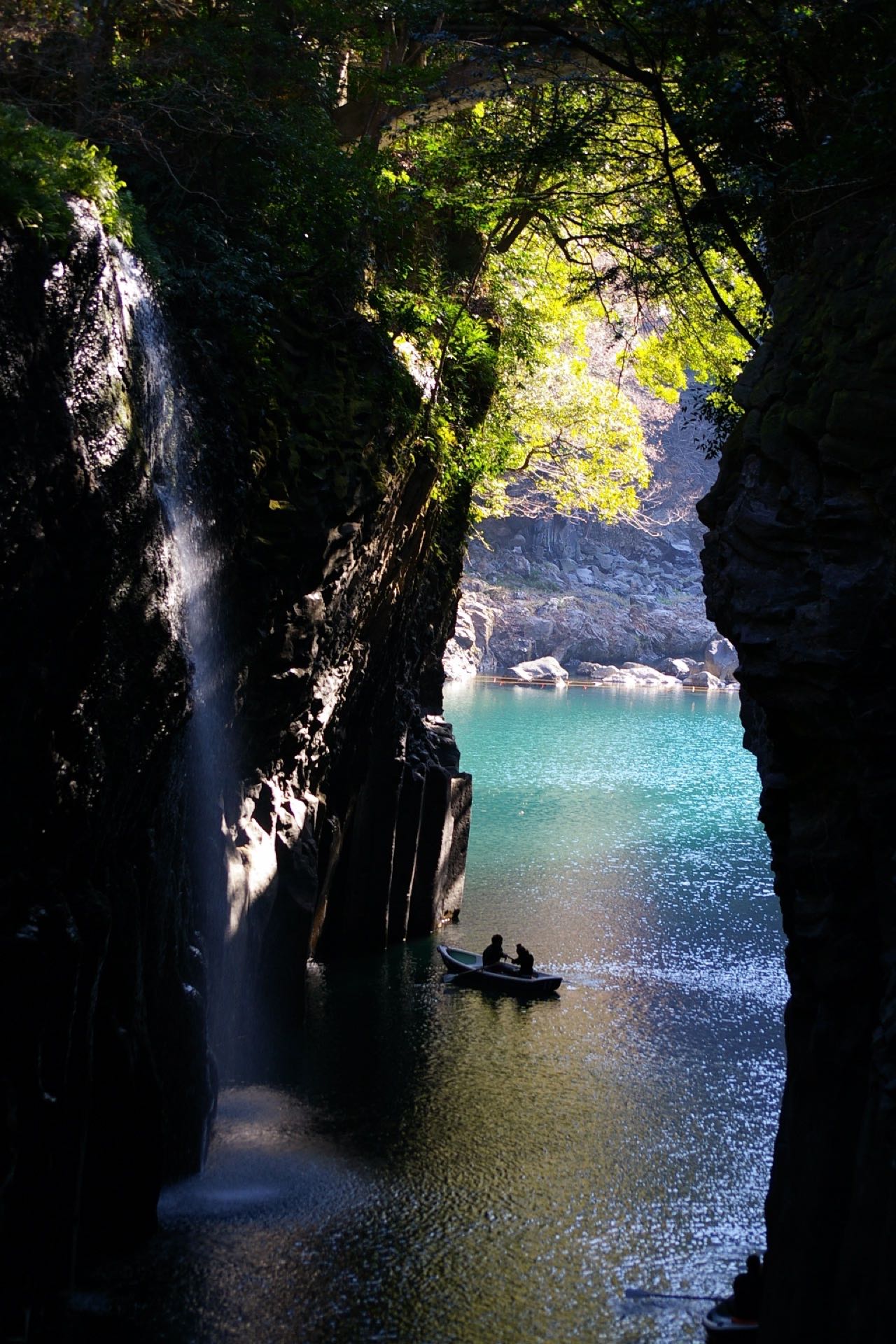 Takasunrise0921 via Wikimedia Commons (CC BY 2.5)
 - Amano Iwato Shrine and the Takachiho Yokagura Shrine year-round; the full village kagura cycle runs roughly November to February, with a nightly abbreviated performance at Takachiho Shrine
Takachiho is where Japanese mythology locates Ninigi's descent from heaven, and Amano Iwato is the cave where the sun goddess Amaterasu is said to have hidden herself, plunging the world into darkness. Yokagura is the all-night masked sacred dance that re-enacts drawing her back out — and it is religious practice, not folklore or entertainment. The full winter cycle is performed in farmhouses across the district, by local people, over entire nights, as part of the agricultural and religious year. The nightly one-hour version at Takachiho Shrine exists precisely so visitors have an appropriate way in. Take that one. Don't go looking for the private farmhouse performances — they aren't a visitor product. Assume photography restrictions, look for signage, and default to not shooting; at Amano Iwato the inner sacred area is not photographable at all.
- Udo Jingū — the shrine inside the sea cave Year-round; 40–50 minutes by car south along the Nichinan coast road
The main shrine building sits inside a cliff cavern facing the open Pacific — you walk down through a vermilion gate and along the cliff face to reach it. It marks the mythological birthplace of Ugayafukiaezu, father of Japan's first emperor. Inside the cave is the ochichi-iwa, a dripping "breast stone," and the shrine sells a candy made from its water. Outside, visitors throw clay undama balls at a target in a twin-peaked rock in the sea below — men throw left-handed, women right — for luck. It's a real ritual with a real form: participate properly or don't. Easily combined with Sun Messe, a few minutes further on.
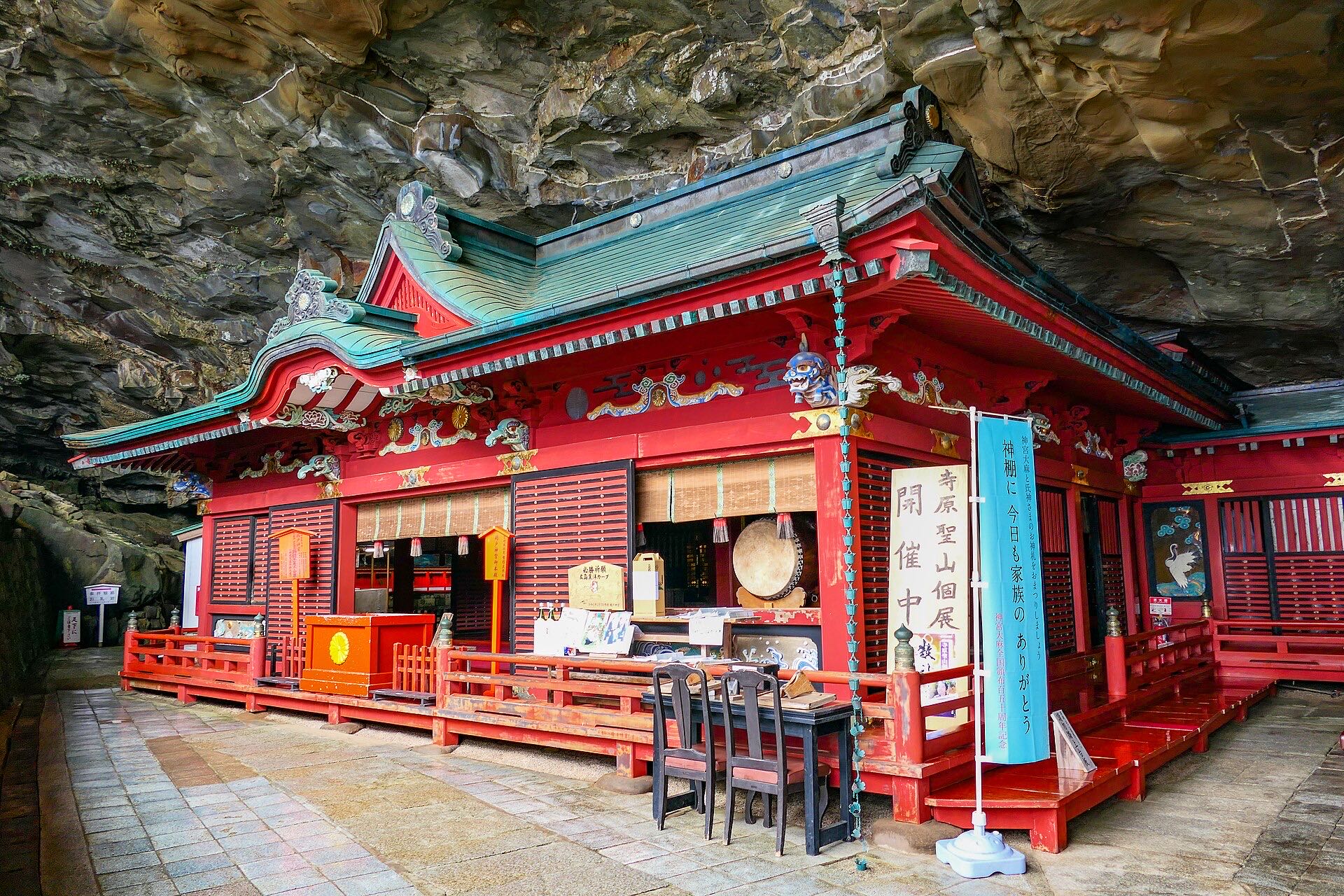 MaedaAkihiko via Wikimedia Commons (CC BY-SA 4.0)
 - Aoshima Island and the Devil's Washboard Year-round, but you want a lowish tide to see the rock properly
A small subtropical island ringed by Oni no Sentakuita — hundreds of parallel wave-cut rock ridges radiating out from the shore in near-perfect regular bands, like a giant corrugated washboard exposed at low tide. It's a designated natural monument. On the island sits Aoshima Shrine, reached by a footbridge and popular for marriage blessings. Travel time is effectively zero: this is inside the hub, a short walk from the surf shops and stays above. Worth remembering it's a working shrine with people praying at it — sitting metres from a car park and a surf beach makes it easy to treat as a photo stop, and it isn't one.
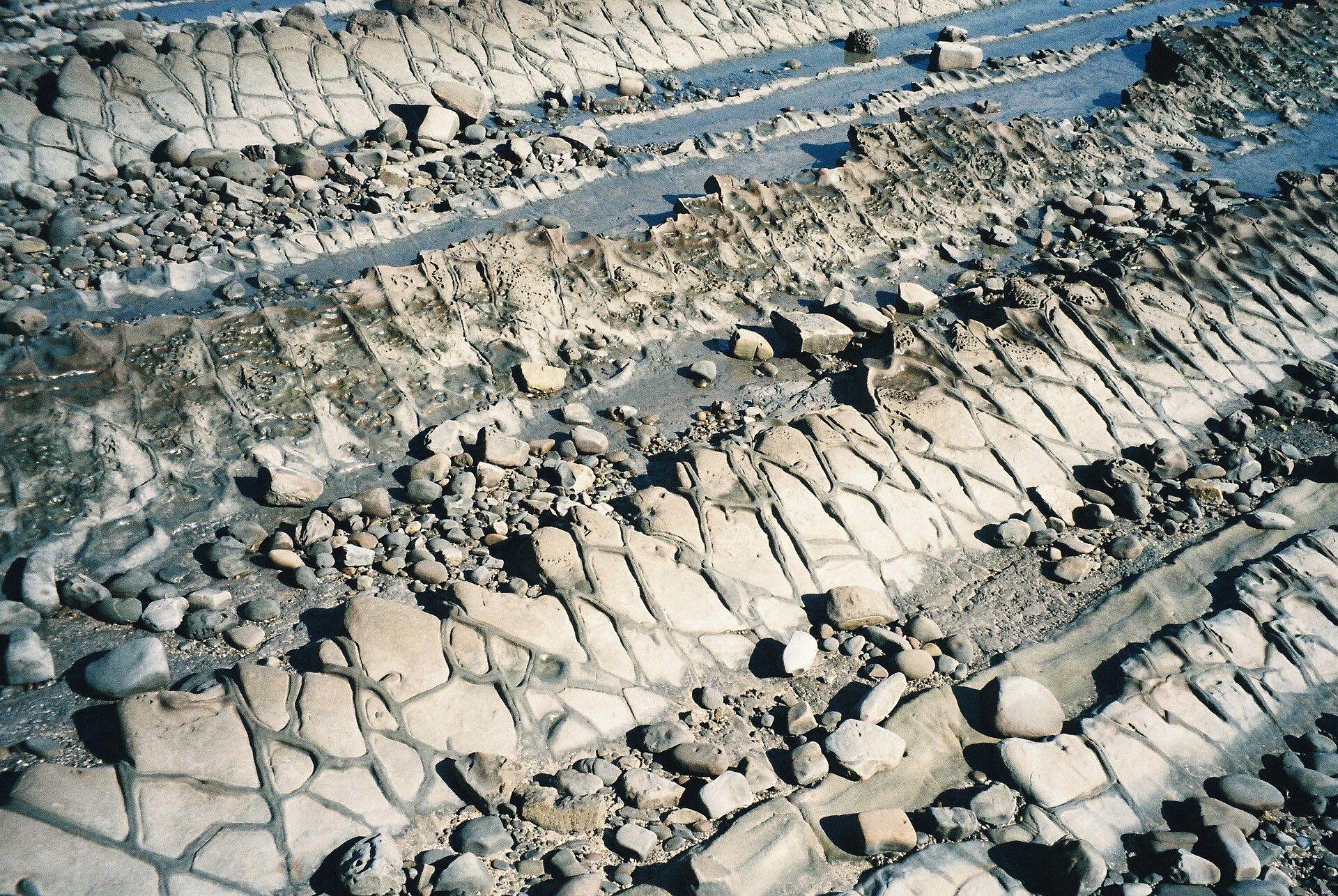 Suikotei via Wikimedia Commons (CC BY-SA 4.0)
 - The Nichinan coast drive Best in clear weather — the road is exposed and no fun in a storm. Allow a full unhurried day
The stretch of Route 220 south of Aoshima is the reason to have a car here: cliffs, palms, the washboard rock formations recurring along the shore, and a string of stops spaced perfectly for a day. Nichinan averages 18.4°C annually, so it's warm and green year-round, and its bonito fishery was designated a Japanese agricultural heritage system in 2021. At the far southern end, Cape Toi holds a population of semi-wild horses.
- Obi castle town Year-round; about 1.5 hours by bus, less by car
A preserved Edo-period samurai district — stone walls, gates, cedar-lined lanes — that was the seat of the Itō clan and produced the Meiji-era diplomat Komura Jutarō. It's small and genuinely quiet, which is its whole appeal: it hasn't been polished into a theme park the way some preserved districts have.
- Sun Messe Nichinan and the officially sanctioned Moai 09:30–17:00, closed Wednesdays; ~40 minutes by car
Full-size replicas of the Easter Island moai on a clifftop above the Pacific. This sounds like exactly the kind of roadside tat you should skip — except that these are, unusually, officially authorised replicas made with the permission of the Easter Island elders, reportedly in acknowledgment of Japanese assistance restoring the originals. Whether that redeems it is your call, but it's a more interesting story than the photos suggest, and the clifftop setting is genuinely good. One practical note: Sun Messe is a paid-admission private facility rather than a public place, so Japan's freedom-of-panorama provision may not cover the replicas — check their own photography terms before publishing your shots commercially.
- Aya, the evergreen forest and the shochu town Year-round; 40–50 minutes by car — a real half-day, unlike Takachiho
Aya holds Japan's largest remaining tract of primeval evergreen broadleaf forest and is a UNESCO Biosphere Reserve — the town made an early and unusually successful commitment to organic agriculture and forest conservation. The Teruha Great Suspension Bridge crosses high above the canopy, and Aya Shusen-no-mori produces German-style beer, wine and shochu at the other end of the day.
Questions people actually ask.
Do I really need to rent a car?
For a surf trip, essentially yes. You can base yourself in Aoshima village, walk to the beach and use the JR Nichinan Line, and Gakky Surf Shop offers free airport-and-beach transfers — so a car-free trip is genuinely possible if you stay put. But the moment you want to follow conditions along the coast, or see anything on the Local Secrets list, you need a vehicle. The surf-specialist rental operators near the airport supply van-type cars with free wet-gear kit, and that's the setup this zone is built around. Mainstream chains will rent you a kei car a 6'2" will not fit inside.
Can I do this trip without speaking Japanese?
Yes, but choose your operators deliberately. Miyazaki Surf Guide advertises English support, SURF CITY MIYAZAKI runs a full English page with published prices, and Seeu has an English-speaking instructor on some dates. Several other excellent shops — Killer Surf among them — say plainly that they can't guarantee detailed English, and that honesty is worth more than a shop that overpromises. Outside surfing, English in regional Kyushu is limited. Download offline Japanese translation before you fly and you'll be fine.
How cold does the water actually get in winter?
Roughly 18–19°C from January through March. These are ballpark figures aggregated from Japanese surf-industry and operator sources rather than a primary oceanographic dataset, but the direction is not in doubt. Local standard kit is a 3mm semi-dry, often without boots or gloves. That's dramatically milder than anywhere else you'd surf in Japan in winter, and it's genuinely the reason Miyazaki has the surf population it does. The thing that ends winter sessions here is wind and air temperature on north-wind days, not the water.
Is August a bad time to come because of typhoons?
It's the riskiest month alongside September, and it's also warm-water and often good-swell season. The honest framing isn't "avoid August," it's "come in August with slack in the schedule and insurance that covers weather." Most August trips are unaffected. The ones that aren't can lose two or three days entirely. If you have exactly five days and no flexibility, aim for late September through November instead — that window gets you swell, warm water and lower typhoon odds.
I have tattoos. Can I use the onsen?
Often not in public baths — but Miyazaki has good workarounds. Honoka no Yu operates entirely as private hot-spring rooms; Aoshima Fisherman's Beachside Hostel & Spa has two private kashikiri baths alongside its main bath; Hotel Aoshima Cinq Mars is listed as tattoo-permitting on the sauna directory sauna-ikitai, though we haven't confirmed that with the venue, so call. Book private, and always ask ahead rather than at the door.
Is Takachiho a day trip from the beach?
Technically yes, realistically no. It's about 2h30m each way by car, or 2h40m each way on the highway bus, with no rail option. That's five hours of travel for a gorge. Stay a night — it also lets you catch the evening kagura, which is the more memorable half of Takachiho.
What about earthquakes and tsunami?
Miyazaki faces the Hyūga-nada sea, in a seismically active region. Coastal areas have marked tsunami evacuation routes and elevated evacuation points — note where yours are when you check in, the same way you'd note a fire exit. If you feel a strong or long quake near the coast, move inland and uphill immediately without waiting for an official warning. Your accommodation will know more than you do; ask them when you arrive.
Disclosure & how this page works.
Straight talk: Some links on this page are affiliate links — if you book through them, Secrets of Surf Travel earns a small commission at no extra cost to you. We only link places and people we'd use ourselves, and coverage is never for sale. Those commissions are what keep this site running and fund the next trip.
Today, the "Search Vrbo rentals" and "Search Booking.com stays" links on this page are affiliate links — every vendor listing link is still a plain courtesy link. As partnerships with these local businesses come online, more links (and discount codes, where Secrets of Surf Travel benefits from their use) may earn us a commission, and this page will keep saying so plainly. Coverage is never for sale: nobody on this page paid to be here, and nobody can.
Every listing was researched in 2026 and is being verified in person. Prices, hours, and policies change — treat them as strong starting points and confirm directly with the business. Several vendors here are one-person operations where the "business phone" is a personal mobile; handle those numbers accordingly. And per the No-Reveal Code: you will find no surf spots on this page, ever. Miyazaki's main beach is a signposted, internationally broadcast competition venue with its own municipal tourism page, so there's no secret to protect there — but the smaller stretches along the Nichinan and Hyuga coasts are exactly the kind of local water where naming and describing breaks does damage. Hubs and towns by name; no break descriptions, no directions to water.